Institutional governance
Architecture authority, decisions
that hold under scrutiny.
Most governance frameworks are designed for compliance, not for decisions. The model I build creates structures that delivery teams actually use — lightweight enough to move fast, rigorous enough to satisfy regulators, transparent enough to satisfy boards. 270+ projects governed across 15 international institutions; 89% of audit findings closed within 12 months of governance activation.
Governance that works in practice
Most governance frameworks fail because they are designed for compliance, not for decision-making. The model I build creates a governance structure that delivery teams actually use — lightweight enough to move fast, rigorous enough to satisfy regulators, transparent enough to satisfy boards.
Used at: NATO/NCIA · UN Secretariat · EEAS · INTERPOL (via contractor) · BRD/Société Générale
Enterprise architecture governance
Enterprise architecture governance is the control system that keeps strategy, platforms, and delivery aligned across complex institutions.
What it means in practice
In practice, enterprise architecture governance means defining a controlled target state, documenting key decisions, enforcing review mechanisms, and preventing fragmentation across projects, platforms, and vendors.
Common governance patterns
TOGAF ADM, architecture review boards, Architecture Decision Records, standards and exception registers with expiry dates, transition architectures, and portfolio rationalisation tied to a governed target landscape.
Typical architecture and governance patterns
Core patterns: target-state architecture, Architecture Decision Records (ADRs), design authority, review boards, standards and exceptions management, transition states, control evidence, and architecture principles. Execution context: cross-institutional transformation, regulated environments, public-sector modernization, and delivery settings where control matters as much as speed. Outcome: fewer duplicated platforms, decisions that can be traced and defended, and savings that show up in the budget.
Why this matters
Without architecture governance, large institutions accumulate drift, duplicate investments, incompatible systems, and unmanaged risk. With it, decisions remain legible, delivery stays aligned, and transformation becomes executable rather than rhetorical.
What I offer
Governance services
ARB charter, membership model, review cadences, escalation paths. A board that speeds decisions rather than slowing them.
Decisions in days, not weeksArchitecture decision record system — ownership, rationale, tradeoffs, audit trail. Every material call documented and traceable.
Full audit trailControl evidence packs, finding registers, closure tracking. 89% of findings closed within 12 months of governance activation.
89% closure rateSecurity policies, architecture policies, data governance policies — mapped to COBIT, NIST, ISO standards and regulatory requirements.
Regulator-readyProgramme governance structures for multi-workstream portfolios. Budget control, milestone tracking, risk registers aligned to architecture.
270+ projects governedExecutive-level architecture and governance dashboards — designed for boards, CISOs and CIOs who need signal, not noise.
Board-level clarityEvidence
Impact in numbers
Figures as recorded on named engagements — each one is listed on the Projects page.
Key engagements
Where governance was mandated
Method
How I approach it
- Baseline honestly. Applications, interfaces, data and contracts — what exists and what it costs.
- Set target and transition states. Where the estate must be in three years, and the steps that are affordable.
- Give decisions an owner. Architecture review board, ADRs and an escalation path with real authority.
- Manage standards and exceptions. Every exception has an owner, a reason and an expiry date.
- Rationalise. Retire, consolidate or replace, with savings tracked to the budget line.
- Measure drift. KPIs on duplication, technical debt and decision lead time reported to the board.
Before you fund it
Risks and questions
Where programmes usually go wrong
- An ARB that approves everything and records nothing.
- Standards with permanent exceptions — the exception becomes the standard.
- A target architecture that is not linked to the budget or the procurement plan.
- Rationalisation counted in applications retired, never in money saved.
- Architects separated from delivery, so the design and the build diverge.
Questions worth asking before you fund it
- How many architecture decisions were recorded last quarter, and how many were revisited?
- Which capabilities are you paying for twice?
- Who can overrule the ARB — and how often has it happened?
- What does one more year on the legacy estate cost?
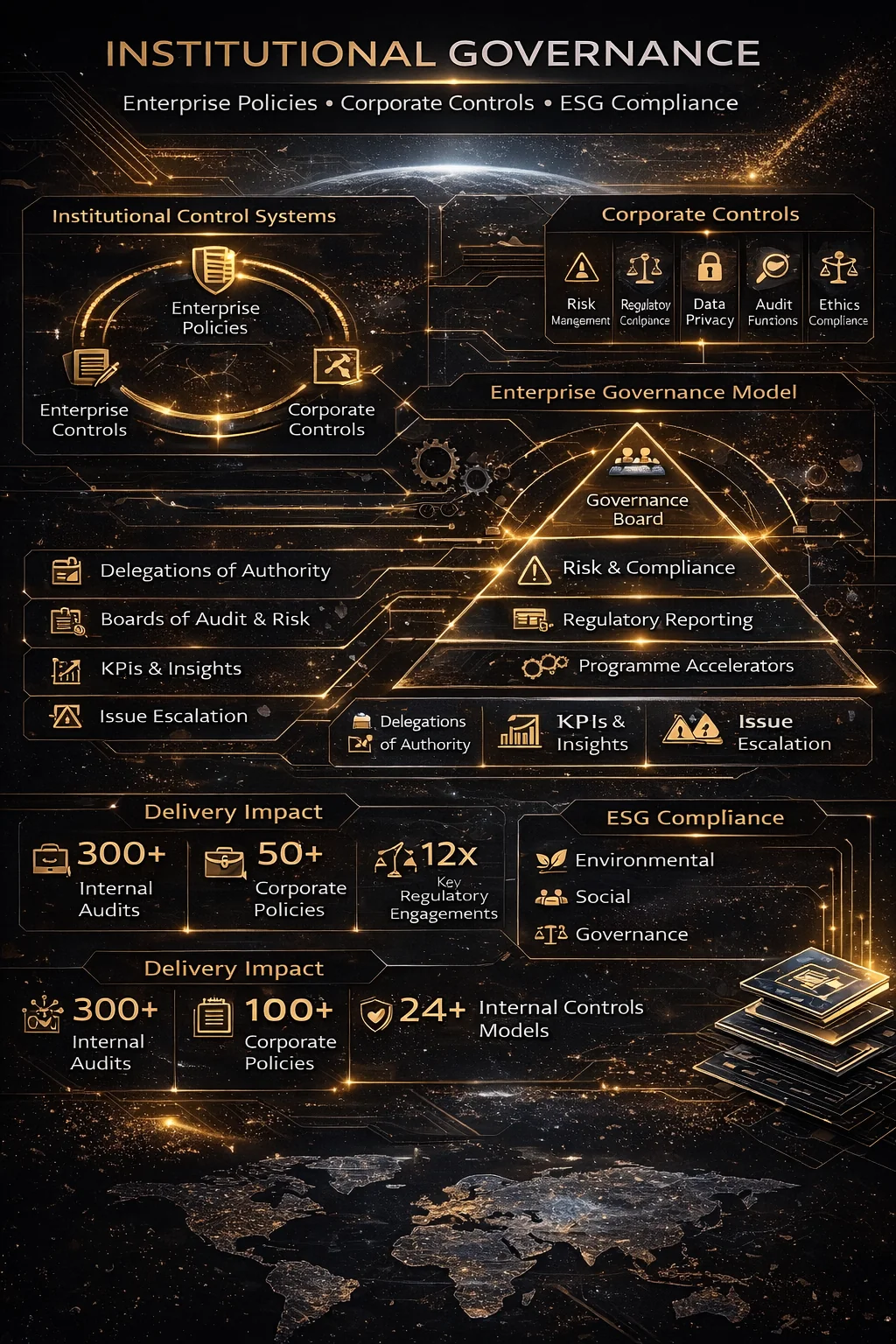
Visual reference
Governance infographic
Need governance that actually works?
ARB design, ADR frameworks, audit-readiness — available for retained advisory mandates.